Does Martyn's Law apply to offices?
Last reviewed:
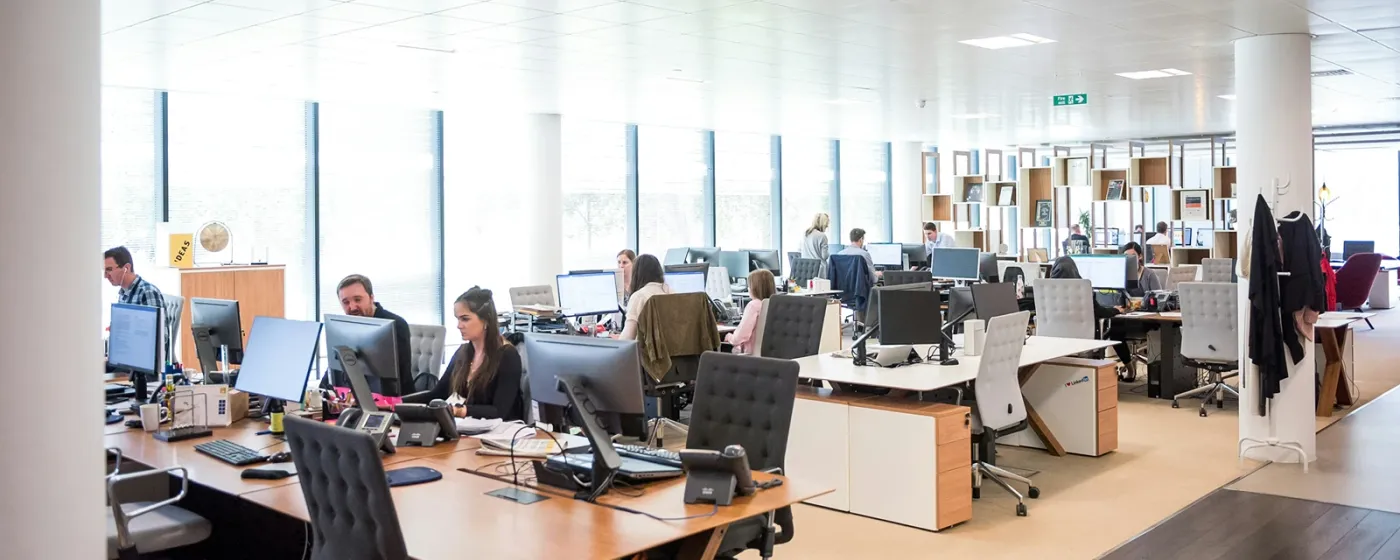
If you manage an office building, Martyn's Law usually doesn't apply to you. An ordinary office, desks, meeting rooms, a staff kitchen, isn't one of the Act's 17 listed uses, and it isn't open to the public in the way the Act means. There are real exceptions worth checking deliberately though, and that's what this guide walks through.
How the tiers work, even though they rarely apply here
It's still worth knowing how the law categorises premises and what those categories demand, in case any part of your building turns out to be in scope. Martyn's Law places public premises into two main tiers based strictly on maximum expected headcount.
Standard tier (200–799 people)
- What it means: focuses on simple, low-cost preparedness.
- Key requirement: notify the regulator and maintain basic procedures for four emergency responses (evacuation, invacuation, lockdown and communication).
- Implications: no mandatory paid training, expensive security upgrades, or heavy documentation are required.
Enhanced tier (800+ people)
- What it means: asks more of high-capacity premises, because of the larger potential impact of an incident.
- Key requirement: includes all standard tier duties, plus formal requirements like a documented vulnerability assessment, a designated senior responsible individual, and measures designed to reduce the premises' vulnerability.
None of this applies to a plain office floor. It only becomes relevant if part of your building is genuinely public-facing, covered below.
Why ordinary offices fall outside scope
Being in scope requires meeting all of the Act's conditions together: a building, used for one of the 17 Schedule 1 purposes, open to the public, and reasonably expecting 200 or more people at once.
A plain office building fails on two of these at once. It isn't a Schedule 1 use, "office" isn't one of the 17 listed categories, and it isn't open to the public, since employees, contractors and business visitors attending for a specific, arranged reason aren't the general public in the sense the Act means. See who Martyn's Law applies to for the full four-condition test this is built on.
Below are three scenarios to help illustrate where the answer flips:
- Office A (out of scope). A standard office floor, desks, meeting rooms, a staff kitchen, used only by employees and pre-arranged business visitors. No Schedule 1 use, no public access, out of scope regardless of headcount.
- Office B (public-facing ground floor). The same building has a café, retail unit or exhibition space on the ground floor, open to anyone off the street, not just people visiting the offices above. That public-facing part can be separately in scope even though the office floors above aren't, the same logic as a factory with a shop attached. See the principal-use test explained.
- Office C (shared building, another occupier). A building with office floors above a public-facing gym or a ground-floor restaurant. The gym or restaurant may separately meet the Schedule 1 and public-access tests on its own footprint, without pulling the office floors into scope with it. See mixed-use premises for how nested and shared buildings are assessed.
One more case is worth a check rather than an assumption: an office building that occasionally holds a genuinely open-to-the-public event, an open day, a public exhibition, a ticketed talk, on a predictable or recurring basis is different from one-off private client meetings. If that kind of public access happens with any regularity, it's worth checking against the "from time to time" rule, since recurring public access can bring a building into scope even if its everyday use is private office work.
A ten-second check for facilities managers
- Is any part of the building genuinely open to the general public, not just employees, clients or invited visitors?
- Does that public-facing part serve one of the Act's 17 listed uses, retail, food and drink, entertainment, and so on?
- Could that part reasonably expect 200 or more people present at once, staff included?
- Does the building host public events with any regularity, not just one unpredictable one-off?
If the honest answer to all of these is no, your office almost certainly sits outside Martyn's Law. If any answer is yes or genuinely unclear, that's the part of the building worth assessing properly, not the office floors themselves. If it does turn out to be in scope, the duties are exactly the ones set out in the standard tier explained, applied to that specific part of your building.
Confirm where your building actually stands with the free tier checker, no email required.
Common questions
Does a staff-only canteen or breakout space count as public access?
No. A canteen, breakout area or meeting room used only by employees isn't open to the public, it's private to the organisation using it, so it doesn't bring an ordinary office into scope on its own.
Do client visitors count as public access?
Generally no. The guidance settles this directly: access that's private or personal to the attendees, invited guests, employees, people there for a specific pre-arranged reason, is not public access (para 5.13). Its own example is a 900-person invite-only corporate networking event, which sits outside scope on access grounds alone, however many people attend. Ordinary business visitors, clients, contractors, interviewees, fall into the same category.
What about co-working spaces?
This one genuinely needs both halves of the answer. First, the members-only model doesn't make premises private by itself, the guidance is clear that limiting access to members or pass-holders doesn't stop premises being publicly accessible (para 4.7), so "it's members only" isn't a reason to rule scope out. But the more fundamental question for a plain co-working office is whether a Schedule 1 use applies at all, and ordinary office space, coordinating desks and meeting rooms for member businesses, generally isn't one of the Act's 17 listed uses. Where a co-working operator also runs a public café, event space or ticketed venue on the same site, that specific part may be assessed separately. See our guide to mixed-use premises for how that works.
About this guide. Written by the Martyn's Law Plan team, based on the statutory guidance published under the Terrorism (Protection of Premises) Act 2025. Last reviewed: . Read the official guidance on GOV.UK.
Sources: Terrorism (Protection of Premises) Act 2025; Home Office statutory guidance (April 2026, updated May 2026) and supplementary documents. Paragraph references are to the statutory guidance. General information, not legal advice. Contains public sector information licensed under the Open Government Licence v3.0.